

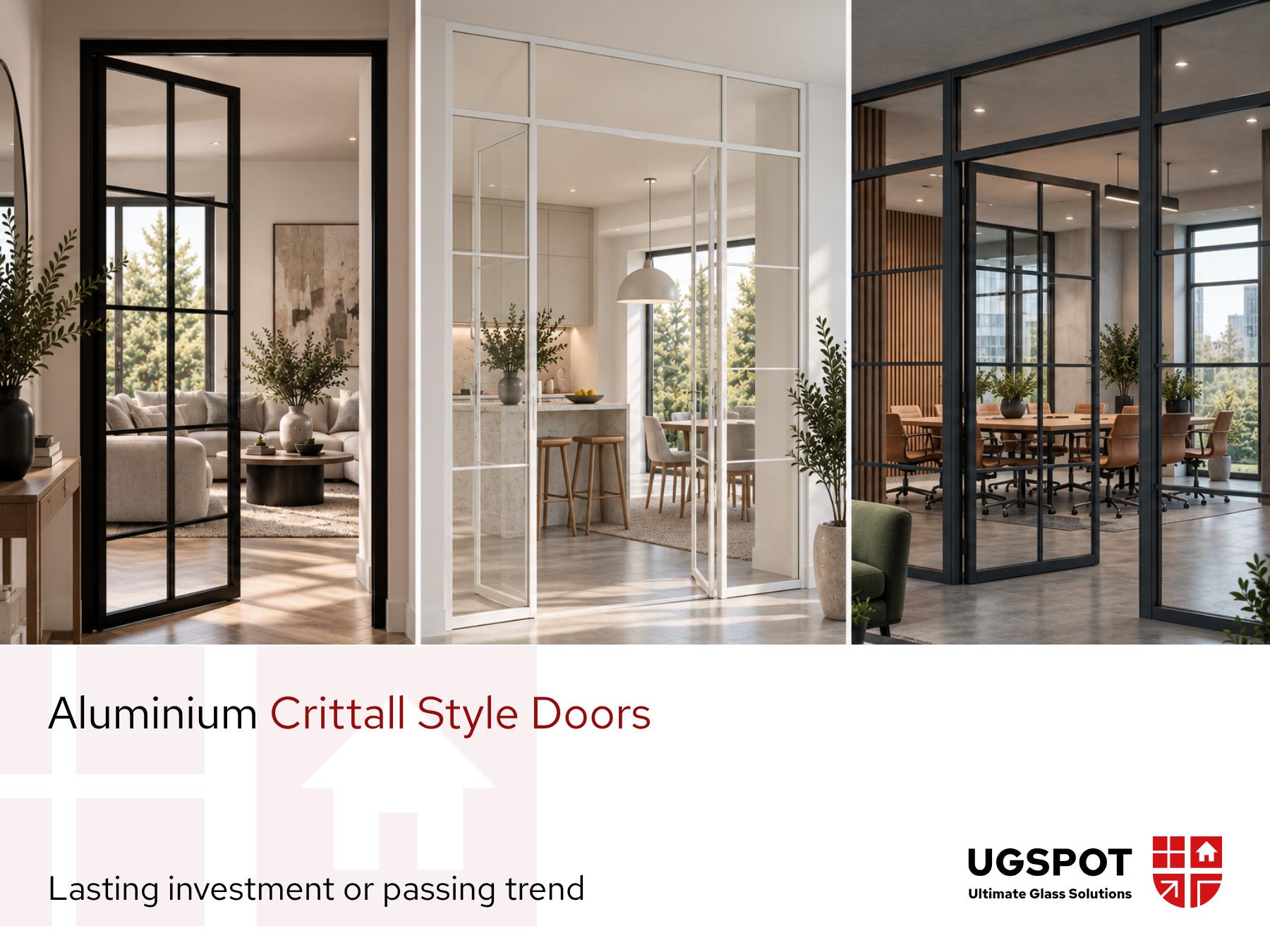
Ask any London builder what homeowners requested most between 2018 and 2026, and black-framed glazed screens will be near the top of the list. Crittall doors have become the standard answer to a very British problem: how to divide a room without giving up the daylight that made it worth dividing. The look now appears in Victorian terraces in Islington, 1930s semis in Hertfordshire, warehouse conversions in Hackney and new-build extensions across the South East.
That ubiquity is why the question keeps coming up. Is this a durable architectural decision, or an expensive way of dating a house to a particular decade? The answer varies by project. It depends on decisions you make before manufacture begins: the grid layout, the material, the glass and, above all, the room the screen is going into.
Three Separate Tests
Home improvement marketing stretches the word “investment”. In strict terms it means a purchase that returns more than it costs, whether in money, use or avoided replacement. That gives three separate tests, and a specification can pass one while failing another:
- Aesthetic durability. Will the look still read as deliberate in 2036, or as a dated renovation cliché?
- Physical durability. Will the product itself still be working, straight and unmarked at that point?
- Financial return. Does the money come back, either at resale or through what the screen replaces?
Most articles on this subject answer only the first, and answer it with opinion. You can test the other two against numbers.

How Old Is This Trend?
The steel-framed window arrived in British domestic architecture in the 1920s and 1930s and stayed. The aluminium version is newer: slim heritage profiles, powder-coated finishes and made-to-measure sizing, which reached the mainstream market from around 2010. The style has roughly a century of history and the current product around fifteen years of it. Neither timeline resembles a fad.
The 2026 UK Houzz Emerging Summer Trends Report tracked the “broken plan” layout, meaning partial walls, level changes and glass partitions that zone a space without losing the flow of open plan, rising 36% year on year. The same report showed far steeper spikes elsewhere:
| Emerging UK trend (Houzz, 2026) | Year-on-year search growth |
|---|---|
| Under-stairs pantry | 275% |
| Hidden utility room | 193% |
| Under-stairs bar | 174% |
| Container home | 171% |
| Broken plan layout | 36% |
| Murphy bed | 20% |
The pattern matters more than the individual numbers. Decorative and novelty features spike hardest and fall fastest; layout-level shifts move slowly and stay. Pinterest's 2026 forecast noted that trends move more than four times faster than they did seven years ago, and that shoppers report trend fatigue as a result. A 36% rise in a year comes from somewhere else: British houses are small, hallways are dark, and the owners who knocked down all their walls regretted it.
Internal glazed screens correct open plan rather than extend it. That is a structural argument for durability, and it applies to crittall doors in almost any period of property.

Test One: Will the Look Date?
Some of it will. The style itself is unlikely to date, but three specification choices within it will.
The bar grid
The most common mistake is treating glazing bars as decoration and fitting as many as the opening allows. Each one adds fabrication time, cost and visual weight. Consider a standard opening of 2400mm × 2100mm, which is 5.04m² of wall.
- With a 35mm perimeter profile and a restrained grid of three vertical and two horizontal 20mm bars, 89.6% of the opening remains glass.
- Increase that to five vertical and four horizontal bars and the glazed area falls to 86.3%.
The difference in daylight is 3.3 percentage points. The difference in appearance is much larger. A dense grid on a wide opening produces the “cage” effect that buyers tire of, and it costs more to achieve. The dating risk here is self-inflicted.
The colour
Black is the default, and default choices are the ones that look dated ten years on. Manufacturers powder-coat frames across the full RAL range, including dual-colour finishes with different shades on each face. Bronze, anthracite, off-white and deep green all read as considered choices rather than catalogue selections, and none of them costs more than black.
The construction
The clearest divide in the market is between systems where the bars are structural and products where the fabricator sticks bars onto a single sheet of glass. The second category is the reason some designers now dismiss the whole style. Applied bars show their edges, collect dust along the join and lift over time. Most cheap crittall type doors use them.
Where the style sits comfortably
Property age matters less than you might assume. Crittall internal doors work in a Victorian terrace because the proportions of a tall, narrow opening suit a vertical grid; in a 1930s semi because the metal window is part of the original architectural vocabulary; and in a new-build extension because there is nothing period to fight against. The awkward cases are properties with strong competing detail: moulded Georgian joinery, or an interior already committed to a different metal finish throughout.
Test Two: Will the Product Last?
This test is the easiest to answer because the data is not contested. Aluminium framing has a documented service life of 30 to 45 years, against 20 to 30 for uPVC and 25 to 35 for timber, which also needs sanding and repainting every few years.
| Frame material | Expected service life | Maintenance regime | Fails by |
|---|---|---|---|
| Aluminium | 30–45+ years | Wash 2–3 times a year; lubricate hinges annually | Hardware wear |
| Steel | 50+ years | Similar, plus corrosion checks in wet rooms | Surface corrosion |
| Timber | 25–35 years | Sanding, sealing and repainting every few years | Warping, decay |
| uPVC | 20–30 years | Low, but finish degrades | Yellowing, distortion |
Two factors push interior installations towards the upper end of that range. First, the powder-coated finish, rated to BS EN 12206-1 on quality systems, resists fading, chalking and peeling for 25 years or more, and indoors it faces no weather and far less ultraviolet exposure. Indoor Crittall doors work in a gentler environment than anything on an external elevation.
Second, and less obvious: most interior screens are single-glazed with toughened safety glass. External glazing depends on sealed double-glazed units, which typically fail at 20 to 25 years when the seal breaks down and condensation appears between the panes. A single toughened pane has no seal to fail. On this measure, internal crittall doors carry lower long-term risk than the external glazing on the same house.
The engineering is simpler too. Crittall doors internal to a house need no thermal break, no weather seals, no drainage slots and no U-value calculation, because none of those requirements apply to a wall that separates a kitchen from a hallway. Fewer components mean fewer failure points, and the parts most likely to need attention over decades are hinges, latches and pivot bearings, all replaceable in an hour without touching the frame.
Aluminium also holds value at the end of its life. It is infinitely recyclable: roughly 75% of the 1.5 billion tonnes ever produced remains in productive use, recycling it uses up to 95% less energy than primary production, and the global recycling efficiency rate stands at 76%. A frame removed in forty years is scrap with a market value. A plasterboard stud wall goes to landfill.
Test Three: Does the Money Come Back?
The marketing claims outrun the evidence, so this test needs care.
No published UK dataset isolates the resale value added by an internal glazed partition. The available studies measure the projects these screens sit inside. Industry analysis of the South East and Hertfordshire market puts loft conversions adding a bedroom at 15–25% return on investment and rear extensions creating a kitchen-diner at 12–20%. Homes upgraded to EPC C attract a reported sale premium of 3–8%. Nothing comparable exists at the level of a single door set, and any supplier quoting a percentage uplift for one is inventing it.
The one large survey worth citing is American: Redfin found 11% of buyers treat natural light as non-negotiable and a further 77% as important, with 53% citing mood and wellbeing as the reason. That is a signal about buyer psychology rather than a valuation multiplier.
The financial case rests on substitution instead: what the screen replaces, and what it avoids. The arithmetic for crittall style doors internal to a house holds up once you price the alternatives for the same 2400mm × 2100mm opening.
| Option for a 5.04m² opening | Indicative 2026 UK cost | Light transmitted | Reversible |
|---|---|---|---|
| Stud wall with standard internal door | £750–£1,400 | Almost none | Demolition only |
| Stud wall with glazed timber door | £900–£1,800 | Roughly 15–20% of the wall | Demolition only |
| Certified fire door set in stud wall | £1,150–£2,100 | None to minimal | Demolition only |
| Frameless glass partition with door | £1,100–£1,600 | Close to 100% | Yes |
| Aluminium screen with hinged or pivot door | £1,400–£2,150 | Around 88% | Yes |
| Bespoke steel equivalent | £3,000–£5,000+ | Around 90% | Yes |
The figures come from published UK cost guides: stud walls run £100–£180 per m² depending on acoustic and fire specification, a door adds £250–£500 installed, a compliant fire door set £650–£1,200, and installers quote black-framed glazed partitions at £275–£425 per m² supplied and fitted. London and South East labour sits at the top of each band. Published starting prices give the range a floor: UGS Ltd quotes from £1,299 plus VAT supplied and fitted for a standard-profile, single-colour, double-glazed internal door, which is close to £1,560 with VAT and lands at the lower end of the band above.
On those figures the crittall doors cost premium over a plastered wall with a door in it is a few hundred pounds rather than a few thousand. That premium buys a room that stays usable and lit instead of becoming a corridor with a cupboard off it.
Three further points affect the crittall doors price in practice:
- Schemes beat single openings. Fabrication, delivery and installation carry fixed costs. UGS Ltd applies package discounts of 5% above £10,000, 10% above £20,000 and 15% above £25,000, which changes the per-opening figure on a whole-floor project.
- Glass drives the quotation more than the frame. Acoustic laminate, fire-rated and patterned options can exceed the cost of the metalwork.
- Specification changes are free before manufacture and expensive after. A survey costs nothing; a remake costs the price of the panel.
When It Is a Fashion Purchase, Not an Investment
In some situations the money does more elsewhere. Five recur often enough to name:
- There is no light to borrow. A screen between two internal rooms with no external window moves nothing. The daylight argument only works when one side of the partition has a source.
- The room needs real acoustic or visual privacy. A single-glazed screen to a bedroom, home office on calls or bathroom will disappoint. Acoustic laminate glazing exists and works, but it costs, and frosted or reeded glass changes the aesthetic that motivated the purchase.
- Building regulations require a fire door. Where a loft conversion creates a storey more than 4.5m above ground level, Approved Document B requires a protected stairway with fire-resisting doorsets and partitions. The same applies between an integral garage and the house. Fire-rated glazed crittall style internal doors work here, but the glass is expensive and the design freedom narrows.
- The property is listed. Internal alterations to a listed building require listed building consent, and a great many London and Hertfordshire terraces are listed or sit within conservation areas.
- The holding period is short. For a rental flat or a property being sold within two years, the substitution logic collapses. Crittall type doors priced as a long-term fixture cannot pay back over eighteen months.
To that list, add the flat-pack category. Kit-form glass crittall doors sold online from around £315 for a 500mm × 2000mm panel serve a real budget market, but they are a different product from a surveyed, made-to-measure installation, so compare kit prices against other kits rather than against a fitted screen.
The Specification That Survives the Decade
The gap between an investment-grade installation and a trend-grade one comes down to a handful of decisions that cost little at the design stage and cannot be undone later.
| Investment-grade | Trend-grade |
|---|---|
| Structural glazing bars welded or mechanically fixed into the frame | Crittall like doors with bars applied to a single sheet of glass |
| Toughened or laminated safety glass to BS EN 12600 in critical locations | Standard float glass below 1500mm |
| Powder coating to BS EN 12206-1, full RAL range | Unspecified black finish |
| Panels proportioned to the opening | Maximum bars regardless of width |
| Surveyed on site before manufacture | Ordered from a tape measure |
| Manufacturer's warranty of 10 years or more | No written warranty |
UGS Ltd, for example, backs its Crittall range with a 10-year manufacturing warranty and up to 25 years across its wider product ranges, designs to BS 6262, Approved Document K and Approved Document B, and quotes achievable panel sizes of up to 1.5m × 3m with larger spans built from multiple slim-profile units. Those are the questions worth putting to any supplier of interior crittall doors, whoever quotes.
Five further specification points repay attention:
- Opening type. Fixed screens, single and double hinged doors, pivots and sliding systems each suit different room proportions. Sliding systems save the swing space that makes a narrow hallway unworkable.
- Hardware finish. Handles, hinges and locks in a matching or contrasting finish separate a considered installation from an assembled one.
- Fixing substrate. Stud walls need noggins in the right places. The surveyor marks these during the site visit.
- Glazing. The pane does more work than the metal. Specifying crittall glass doors with acoustic laminate, fire-rated, reflective or patterned glass changes what the screen does without changing how it looks from three metres away.
- Sightlines. Aluminium heritage profiles around 35mm and steel at roughly 20mm look different in the same opening. Both work. Mixing the two in one property reads as an error.
Most comparisons leave out disruption. Building a stud wall means timber, plasterboard, taping, plastering, drying time and two coats of paint, typically a week of a room being unusable and a further period of the smell of fresh emulsion.
A surveyed screen arrives finished, and a fitting team installs it in a day, with no wet trades and no redecoration. The waiting happens off site rather than in the house: UGS Ltd quotes a lead time of 15 days on a standard specification, during which the room stays in use. On a lived-in house in London, where moving out is not an option and each week of works carries a real cost, that difference is worth more than the quotation suggests.
Where That Leaves the Decision
Against the three tests, aluminium crittall interior doors pass two and pass the third with conditions.
The product durability case is settled: 30 to 45 years of service life, no sealed unit to fail, a finish that does not need repainting, and a frame with scrap value at the end. The aesthetic case is stronger than it looks: the style is a century old, current demand is layout-driven rather than decorative, and the buyer chooses the elements most likely to date, meaning bar density, black-by-default and applied bars.
The financial case needs judgement. As a specification upgrade within a project already going ahead, whether a reconfigured hallway, a kitchen opening or a home office carved out of a reception room, the premium over a plastered wall is modest and buys something a wall cannot. As a standalone purchase intended to add resale value on its own, it will disappoint, because no internal door of any kind does that.
Interior crittall style doors are an investment when they solve a layout problem in a house someone will live in for years, and a fashion purchase when they go in as a feature. The product is the same in both cases; the reasoning differs, and that is the part worth settling before the survey.